Showing posts with label energy. Show all posts

Friday, September 30, 2011

10 Ways to Cut Your Home Heating Bill

Let’s keep our homes warm, happy, clean and green this winter! The green revolution isn’t just about doing right by the planet. It’s also about doing right by our pocketbooks.

(Flickr Creative Commons image by Zeusandhera)

  1. Clean energy – A clean furnace is an efficient furnace. Check your filters, check your ducts, dust off radiators (dust insulates them and keeps heat in). Replacing a furnace filter is cheap, and dirty filters cut your efficiency and can cut your furnace’s lifespan. Get your furnace inspected and maintained - a badly tuned furnace wastes $30 a month on average, so this pays for itself very quickly. And make sure your vents aren’t blocked by furniture – that cuts efficiency, too. (Flicker Creative Commons image by westy559)
  2. Heat Smart – First, drop the temp; each degree you cut clips 3 to 8 percent from your bill. Next, get wet – moist air holds heat better and FEELs warmer. You can add a humidifier to your furnace, buy a freestanding one, or just keep a kettle on the stove pumping out steam. You’ll feel the difference within minutes.
  3. Thermostat Timer – This is actually the only piece of high-tech on our list. Putting it in is an easy do-it-yourselfer; programming can be trickier, but once you get the hang of it you can save 10 percent or more. Many even now come pre-programmed to drop the temperature during down-times, like work hours during the day or when you’re all in bed at night, and then bring up the temp just before you come home or wake up, so you’re always comfy.

    (Ceiling Fan by NorthernFan.com)

  4. Circulation – Heat rises. Use your ceiling fans to circulate air (or install them if you don’t them, and get the cooling benefit in summer as well). Cut back on using kitchen and bathroom ventilation fans for the season – they suck your valuable warm air right out of the house. Also, close off rooms that aren’t being used, and shut the heat vents in there.

    Ultratouch Natural Cotton Fiber Insulation - cozier than fiberglass

  5. Insulate - Got insulation? Better check – bats can sag, leaving gaps, and animals can slip in, making holes. Now’s the time to make sure by taking a quick look. Also, make sure you’re covered all over – attics and crawl spaces might have been overlooked. Need insulation? This can be a big ticket item, but compared to the average $1900 cost of heating a home, it’s a no-brainer. And adding insulation doesn’t just save you money now – it adds to your home’s value. Along with replacing old drafty windows, and replacing an old, inefficient furnace, this is one investment that pays off both in the short term and the long term. Talk to your bank about an equity credit line…
  6. Mind the gaps! – I’m sure by now you know to caulk and weather-strip around doors and windows, and make sure to cover gaps between doors and thresholds. But there are a few places you might not have thought of, like electrical outlets. On outside walls, these can make a gap in your insulation blanket – you can buy small foam inserts that go under the switchplates. You should also check around pipes under sinks, and fill any gaps with foam. Of course, you should make a point of keeping all doors and windows closed – and close garage doors as quickly as possible. And close the chimney damper! That alone can hit you 10 percent. Putting a blanket over your fireplace screen when the fireplace isn’t in use can also help cut drafts. (Flicker Creative Commons image by Phototrope)
  7. Use the sun! – You don’t have to have an expensive passive solar setup installed (although that would be great) – you’ve got windows, so let the sun in during the day. It’ll warm the interior, providing free watts of energy.
  8. Windows of opportunity - When the sun goes away at night (or on cloudy days) keep the blinds, shades and curtains closed to prevent heat from radiating out through the glass (you could lose 10 to 20 percent of your heat that way). Installing heavy drapes is good, but you can also install 2-mil plastic sheeting that ups the insulation factor hugely (put it up with blue painter’s tape, which leaves less residue). Replace those ancient windows if you can. (Flickr commons photo by sweet mandy kay's )
  9. Snug in your bed – A thick down comforter might cost a bit, but if you’re bundled up and cozy you can save a bundle by cutting the heat to 60 degrees while you snooze. Woodstove by Quadrafire
  10. Wood stove – Depending on where you live, installing a wood-burning stove can save you quite a bit. Just make sure you run it efficiently (pointers here). And splitting wood warms you up like you wouldn’t believe.

One other important tip - get everyone in the family involved! Emphasize the planet-saving aspects, and the kids will be happy to join in. And that’s a lot easier than yelling at them 10 times a week to keep the darn door closed….

Image Credits:

Tuesday, February 02, 2010

Obama Budget Cuts Oil Money, Adds Renewables

After criticism for not talking enough about renewables in his SOTU speech, President Obama’s new budget shows us the money - according to a White House statement, more than $6 billion. But is it enough? You’d think that with a total of $3.8 trillion on the table, a few more crumbs could have been tossed toward energy - and planetary - security.

“The President’s budget cuts wasteful spending while making wise investments in innovation and clean energy that will put Americans back to work, save families money and keep our nation competitive in the global marketplace,” said Energy Secretary Steven Chu. “This budget supports new approaches to energy research and invests in the next generation of scientists and engineers, and it will spark new clean energy projects nationwide, including restarting the American nuclear power industry.”

“America must move to a clean-energy economy,” Interior Secretary Ken Salazar said. “We believe that the taxpayers should receive a fair return on the resources that belong to them.”

The DOE reports the good news on the fossil fuel front, as the new budget cuts the following:
* Eliminating more than $2.7 billion in tax subsidies for oil, coal and gas industries. This step is estimated to generate more than $38.8 billion dollars in revenue for the federal government over the course of the next 10 years.
* Another $8.5 billion would come in by cutting a tax break oil and gas companies currently get for taxes paid oversees.
* Terminating Ultra-Deepwater exploration program, saving $50 million.
* Canceling planned expansion of the Strategic Petroleum Reserve, saving $71 million.
* There’s also a new fee on “non-producing” leases - a modest $4 an acre that would encourage companies are currently sitting on leases without doing any drilling or exploration (even while they try to get more and more areas opened up for leasing) to start doing something with them. That is estimated to bring in $1.15 billion.

There is also word that $2.3 billion in tax breaks for coal will be cut over 10 years as well.

And for green energy:
* More than $217 million in new funding for science research and discovery, including an additional $40 million for the existing Energy Frontier Research Centers program and $107 million for Energy Innovation Hubs.
* $300 million for the Advanced Research Project Agency – Energy (ARPA-E);
* Lending authority to support approximately $40 billion in loan guarantees for innovative clean energy programs. (But $36 billion of that is an increase in guarantees for new puclear plants)
* More than $108 million in new funding to advance and expand research in the areas of wind, solar and geothermal energies.
* $43 to the EPA for greenhouse gas reduction under the Clean Air Act
* There are also millions more in funds for water cleanup, including $300 million to restore the Great Lakes (we’ll be writing more about this)

Energy Boom breaks out some more numbers:

$4.7 billion in clean energy technology investments at DOE, including:
* Nearly $2.4 billion, an increase of $113 million, for energy efficiency and renewable energy programs including $302 million for solar energy, $220 million for biofuels and biomass R&D, $325 million for advanced vehicle technologies, and $231 million for energy efficient building technologies.
* $545 million for advanced coal climate change technologies to focus resources to develop carbon capture technologies with broad applications to advanced coal power systems, existing power plants, and industrial sources.
* $300 million for the Advanced Research Projects Agency–Energy to accelerate game-changing energy technologies in need of rapid and flexible experimentation or engineering.
* $793 million for clean energy activities and civilian nuclear energy programs, including research and development and infrastructure programs. The budget includes a new cross-cutting research program to address technology needs for all aspects of nuclear energy production.


And as Josie Garthwaite at Green2Tech notes,

Makers of green energy equipment could also benefit under a proposed $5 billion expansion of a tax credit first created as part the stimulus package, which covers up to 30 percent of the costs for new, expanded or retooled greentech equipment factories. That likely comes as welcome news for the companies behind several hundred projects that didn’t make the cut for $2.3 billion in credits awarded last month under the oversubscribed program.

Garthwaite also points to something missing from this budget: revenue from carbon allowances, “signaling dwindling confidence that the Senate will pass a bill with a cap and trade system this year.”

But President Obama doesn’t appear ready to throw in the towel on that one yet. In a press conference, he said “Because our future depends on our ability to break free from oil that’s controlled by foreign dictators, we need to make clean, renewable energy into a profitable kind of energy. That’s why we’ll be working with Congress on legislation that places a market-based cap on carbon pollution and drives the production of more renewable energy.”

You can get the DOE budget here or the Federal Budget here if you want that level of detail.

Do Something Now!

If you want a quick way to get involved, write to your Senator/Congressperson and tell them you support increased money for green energy.

Drop a note to President Obama thanking him for supporting renewables.

(Originally appeared at TenthMil.com)

Thursday, January 28, 2010

Red State, Blue State, State of the Union

Okay. President Obama talked about jobs, about energy, about jobs, about climate, and about jobs. Did we mention jobs?

As President, it’s not his job to make everybody happy. But it helps if he wins over more than 51 percent.

Some folks were definitely happy. Steven Cohen, Executive Director of the Earth Institute at Columbia University, wrote at the Huffington Post:

I continue to root for Barack Obama. Blunt and tough was just the right tone for his first State of the Union. While I expected him to submerge climate policy within the veneer of energy and employment policy, I was impressed that he addressed it so directly

So was “billyparish”, writing at Its Getting Hot In Here:

But from the standpoint of an aspiring green entrepreneur, there was an awful lot to like in the speech. This was the jobs speech it needed to be, and it continued what may be the overarching theme of his presidency, “to lay a new foundation for long-term economic growth.” ...But more than any speech we’ve heard from him before, he put clean energy jobs at the absolute center of his job creation strategy, mentioning clean energy 10 times, solar twice and climate change 3 times. His discussion of U.S. competitiveness in the global economy is entirely framed in the context of the race to develop clean energy technologies.

And Frances Beinecke, president of the Natural Resources Defense Council, was more than pleased:

President Obama issued a clear and unmistakable call to action tonight, charging the Senate to pass the comprehensive clean energy and climate legislation we need to put Americans back to work and lay the foundation for a generation of prosperity, efficiency and security.
The President could not have been more clear: This legislation will jump-start economic growth, reduce our reliance on foreign oil and roll back the pollution that threatens our future. The Senate should pass it without delay.
The President is right on the money. His plan will get Americans back on their feet. Now it’s our job to let our Senators know where we stand. This is our moment. This is our charge, too. It’s time to pass comprehensive clean energy and climate legislation and put America back to work.

It looks like he did well overall. A CBS News poll found 83% of speech watchers approved of Obama’s proposals, although his harshest critics on the right probably weren’t watching to hear some of the olive branches he offered them.

And those olive branches didn’t exactly enamor some of the doves of the left. Progressive organization MovOn.org ran a mega-focus group – more than 10,000 MoveOn members in a real-time “dial test”, providing instant feedback that allowed them to create a moment-by-moment reaction roadmap throughout the speech.

The lowest-rated phrase in Obama’s SOTU? Not too surprising:

That means building a new generation of safe, clean nuclear power plants in this country. It means making tough decisions about opening new offshore areas for oil and gas development.

This phrase got a better reaction (although Republican legislators laughed out loud at “overwhelming”):

I know that there are those who disagree with the overwhelming scientific evidence on climate change,” he said. “But even if you doubt the evidence, providing incentives for energy efficiency and clean energy are the right thing to do for our future.

Some who have been fighting for clean energy were disappointed at the President’s version of “clean energy”. Like David Roberts at Grist:

...what [“clean energy”] means was, in order: nukes, offshore oil and gas drilling, biofuels, “clean coal,” and ... well, that’s it. That’s right, in listing what “clean energy” means the president did not mention renewable energy. That’s just stunning. It’s 2010 and renewable energy isn’t even an afterthought? Seriously?

Or the Get Energy Smart Now blog, which drew a sharp contrast between SOTU 2009 and SOTU 2010:

In 2009, President Obama made a strong and uncompromising call for investments in “clean, renewable energy” and made a direct statement about the type of climate legislation expected from Congress (”market-based cap on carbon pollution”). He provided a meaningful opening target: “we will double this nation’s supply of renewable energy in the next three years”.
In 2010, President Obama did not even mention the word “renewable”, failed to refer back to the strong statements about renewable energy in the 2009 SOTU and how we on track to achieving (and likely exceeding) them, and sounded like he could have been speaking to the Republican National Convention in the Luntz-ian like redefinition of a “clean energy economy”...

What was Obama thinking, calling for more nukes? He’s probably thinking of Senators John Kerry (D-MA), Joe Lieberman (LIE-CT) and Lindsey Graham (R-SC) who are trying to put together a bi-partisan climate bill. Whether or not he won any hearts and minds on the other side of the aisle, he didn’t endear himself to his supporters.

As commenter “shiplord kirel” offered over at rightwing blog Little Green Footballs:

With the kind words for coal and nuclear, O has grabbed his last few far-left supporters by the scruff of their scruffy necks and tossed them right under the bus of state.

Obama also may have been pitching to those notorious “swing voters” that everyone has been so concerned with. Democracy Corps did a focus group of swing voters, and found that their approval of the President jumped from 44 percent pre-speech to 60 percent after.

They didn’t ask about green initiatives specifically, so we don’t know the group’s reaction on that front (although his “Tax the Banks” plan was wildly popular.)

But we do know one thing: Swing voters liked what they heard, but have doubts as to whether he can deliver.

Unlike most attributes that shifted during the speech, “promises things that sound good but won’t be able get them done” remained very high (78 percent pre-speech to 74 percent post-speech). The “shifters” in these post-speech focus groups are waiting for results, and they pointed specifically to passing health care reform and job creation initiatives as critical reforms that must be delivered. While they see the Republicans as obstructing every Obama initiative, they nonetheless expect Democrats to pass major legislation with their large majorities.

One final poll number: last week Republican Pollster and media guru Frank Luntz reportedon a national survey with some encouraging results:

• 57 percent agreed with the statement: It doesn’t matter if there is or isn’t climate change. It is still in America’s best interest to develop new sources of energy that are clean, reliable, efficient and safe.
• National security is the main reason that people support cap and trade. Across the demographic board, people liked the idea that clean energy will liberate us from this oil addiction.

You want bi-partisan? It sounds like there’s already a bi-partisan consensus in this country. We just have to wait for our politicians to tap into it.

(Originally appeared at TenthMil.com)

Wednesday, January 27, 2010

DOE Takes Baby Steps on Geothermal and Earthquakes

What’s the real scoop on Geothermal and earthquakes? Despite a NY Times report that has been picked up by other outlets, (for instance, here and here), the Department of Energy (DOE) is not initiating any major new regulations for Geothermal projects.

What they have done: building on the experience at The Geysers geothermal field in California, they are issuing a new policy that will apply to “all new Enhanced Geothermal [Systems (EGS)] projects, including those recently funded through the Recovery Act.” The Obama Administration is providing $338 million in funding to a total of 123 projects, although there are no figures on how many of those involve EGS, which generally fractures rock deep in the Earth to allow water to more easily flow through, collecting heat that can then be used to generate power. Mico-quakes cansometimes be produced by slippage along those fractures.


(Image: AltaRock Energy)

According to a DOE letter to the office of Congressman Henry Waxman (D-CA) obtained by TENTHMIL, the policy will feature:

• The Department will require grantees to collect stress data, background seismicity, and geology data prior to actual field stimulation. Once the data are collected, the grantee will use predictive stimulation models to estimate and forecast potential induced seismicity magnitude and potential radius of seismicity. Information submitted by grantees will be used to develop site specific risk mitigation strategies.
• The Department will task a team of experts to review these results as a part of a go/no-go decision point.
• If judged satisfactory, grantees will be given the go-ahead to conduct field work with adequate permits from local authorities. Otherwise, they will be asked to gather more data and conduct more analysis.

This comes on the heels of two projects – The Geysers, in California, run by Seattle-based AltaRock Energy, and a project in Basel, Switzerland. Both of them were in populated areas near seismic zones – and both were recently shut down after jolting local residents. In both cases, the companies were experimenting with EGS technique.


(Image Source DOE, AltaRock Energy)

Scary Words

The NY Times story opened with, “The United States Energy Department, concerned about earthquake risk, will impose new safeguards on geothermal energy projects that drill deep into the Earth’s crust.” Some picked up the drumbeat and inserted the words “new regulations.” But the DOE isn’t taking things quite that far.

Ernest Majer, a geothermal expert and deputy director of the Earth Science Division at Lawrence Berkeley National Laboratory in California, told TENTHMIL, “We’re in the process of reevaluating what sort of mitigation controls will be put on. They’re not regulations, and we don’t want to put regulations where they’re not necessary.”

On the other hand, he said, the experience that AltaRock had drilling at The Geysers has taught everyone some important lessons, and they wanted to bring that to the table. And they mostly appear to involve the application of common sense when you’re doing seismically sensitive drilling and fracturing in an area with a lot of buildings.

That’s what caused trouble for the Basel project – it was in the middle of town, where even the smallest jolts will shake people up and potentially leave cracks in buildings. There were fewer people living around The Geysers, but they weren’t any happier about the temblors – or about the way their concerns were dismissed.

“It’s ironic,” notes Majer, “because AltaRock’s drilling never even made it below the caprock. They went into an existing well and got jammed up, which was probably their problem – in old wells things can shift.” They never even got as far as fracturing the rock down in the geothermally-interesting heat zone.

But what happened was a public-relations problem. Because they’re experimenting with a new, proprietary process, Majer says the company couldn’t be forthcoming in describing what they were doing, and people got suspicious.

“They’ve got another project at Newberry, Oregon” that they’re moving forward with, he adds. Not only is that site far from people, the ring-fracture system of the Newberry Volcano will limit the dispersal of any potential stresses.

“That seems like a more attractive prospect for experimenting right now,” so they wrapped things up at The Geysers, even as the DOE was finding that the quakes there, while disconcerting, wouldn’t have had an impact on the local population.

(Originally appeared at TenthMil.com)

Friday, January 15, 2010

Geothermal Pitches Wall Street

Representatives of the Geothermal Energy Association had their largest schmooze-fest ever in New York Thursday (Jan. 14). They met with Wall Street financiers, had lunch with politicians, including Senate Majority Leader Harry Reid (D-NV), Mayor Bloomberg declared “New York City Geothermal Energy Day”, and at the end of the day they even got to ring the closing bell on the stock exchange - well, on the smaller and less prestigious NASDAQ, but it’s still an honor.


Will Geothermal always remain the poor cousin of the better-established solar and wind industries?

The New York Times reports:

Overall, advocates say, geothermal technology is proven and has distinct advantages over wind and solar. Geothermal power is a steady and reliable baseload, which electric utilities appreciate. And geothermal plants use less land than wind farms or solar arrays.

But [the GEA Executive Director Karl] Gawell admits major Wall Street investment banks shy away from geothermal because it takes years to see a return on investments. A Nevada project that came online last year took five years to complete, compared with a lead time of little more than a year for a standard wind farm.

“They’re realizing that geothermal can be a good investment,” Gawell said. “You’ve just got to stay in there a little bit longer.”

Gawall also stopped in at the Wall Street Journal to pitch them on earth power, noting that 200 megawatts have come online in the past year.

“It’s being rediscovered in the U.S.,” Mr. Gawell says. While the U.S. is currently the world leader, the geothermal industry today is where the wind-power industry was 20 or 30 years ago, he says.

And given the role that big corporates—such as General Electric and Siemens—played in the explosion of the wind industry, the logical question is, when will big companies pile into geothermal? GE has been showing up at geothermal meetings lately, Mr. Gawell says, and GE Energy Financial Services finances some geothermal investments.

Analyst Byron King says it’s time the big companies jumped in and took over from the “mom and pop” operations. In his Energy & Scarcity Investor (via BeforeItsNews.com), he says:

The pre-crash business model of the geothermal industry is no longer appropriate to the tight-credit world in which we live… Post-crash, it’s clear that most publicly traded geothermal companies are too small. Back when credit was cheap, money flowed more easily and you could “afford” to be patient over a five-to-eight-year time frame. The same small team of developers was prospecting, leasing, drilling, finding, assessing, fundraising, developing, building, stringing electric line and selling power. Holy smokes, Batman! Where’s the point where we can MONETIZE this?

But in our new economic world, the small, mom and pop business approach just won’t cut it. Geothermal power takes too much upfront capital to make things work. It requires too many different management skill sets. Like many things in life, bigger is better with geothermal. In fact, the world’s largest geothermal producer is Chevron Corp. Is that big enough?

At least some of the investors are excited:

By 2012, “we think the strategic landscape starts to change quickly,” said Paul Leggett, a vice president of investment banking at Morgan Stanley. “We do think the geothermal industry is ready for a takeoff.”


(Originally appeared at Tenthmil.com)

Tuesday, January 12, 2010

Biomass or Biomess?

One of the things we should have learned from the corn to bio-ethanol mess of the past five years is: haste makes waste.

The subsidies that were supposed to help create a sustainable industry and help small farmers instead turned into a massive hand-out to big agriculture, and drove up prices on corn and other food when it was diverted to fuel - and the socalled green bioethanol turned out to cost almost as much CO2 as fossil fuels.

Now, the Washington Post reports the same thing is happening with wood biomass. Subsidies that were supposed to create green fuel are instead warping the market:

In a matter of months, the Biomass Crop Assistance Program—a small provision tucked into the 2008 farm bill—has mushroomed into a half-a-billion dollar subsidy that is funneling taxpayer dollars to sawmills and lumber wholesalers, encouraging them to sell their waste to be converted into high-tech biofuels. In doing so, it is shutting off the supply of cheap timber byproducts to the nation’s composite wood manufacturers, who make panels for home entertainment centers and kitchen cabinets.

Of course, subsidies are an important tool for jump-starting the green economy. But not the way the wood biomass subsidies were written.

Biomass energy representatives, such as the Biomass Power Association president, Bob Cleaves, said those subsidies are critical to support a sector that currently supplies half of the nation’s renewable energy (the other half coming from wind, solar and other sources). Seven of Maine’s 10 biomass energy plants would have shut down without the new influx of funds, he said.

“The industry needs help,” Cleaves said. “Is the country not prepared to spend half a billion dollars on half the country’s renewable energy resources?”

The Agriculture Department, for its part, says it has no choice but to implement the subsidy the way Congress envisioned it under the 2008 farm bill. That legislation made no distinction between a waste product with little market value, such as corn husks, and the sawdust that sells for roughly $45 a dry ton.

Senator Tom Harkin (D-IA) is looking into the problem, and so is the Office of Management and Budget. So hopefully that means we’ll be seeing this fixed fairly quickly. Everyone agrees that some form of subsidy for biofuels is a very good thing - when it encourages the market in the right way.

But pellet mill owners such as the Rolf Anderson, chief executive of Bear Mountain Forest Products, said the program will eventually create an incentive for people to bring small pieces of wood left by loggers out of the forest, which will give companies like his a cheap and steady stream of raw materials.

“It opens up economic opportunities. It opens up healthier forests, and it helps companies and individuals save on their energy costs,” said Anderson, whose company is based in Oregon.

The problem with subsidies, though, is once companies start getting millions of dollars from the public trough, they lobby hard to keep the flow coming. Why? Because companies can easily afford to donate tens of thousands of dollars to campaign coffers if it means millions of dollars in government funding. The 2008 Farm Bill that contained this biomass provision was widely derided as a bloated mess that ended up pouring billions into Big Ag without really helping out struggling farmers.

What can you do? Write your Senators and Representatives and tell them to get it right.

(Originally appeared at TenthMil.com)

Tuesday, November 10, 2009

US (=Bush) Pressured IEA to Inflate Oil Reserve Numbers


Did the International Energy Agency inflate oil reserve figures to make it look like we're not facing peak oil?

That's what the Guardian is reporting, based on statements by a whistleblower:
The senior official claims the US has played an influential role in encouraging the watchdog to underplay the rate of decline from existing oil fields while overplaying the chances of finding new reserves.

The allegations raise serious questions about the accuracy of the organisation's latest World Energy Outlook on oil demand and supply to be published tomorrow – which is used by the British and many other governments to help guide their wider energy and climate change policies.

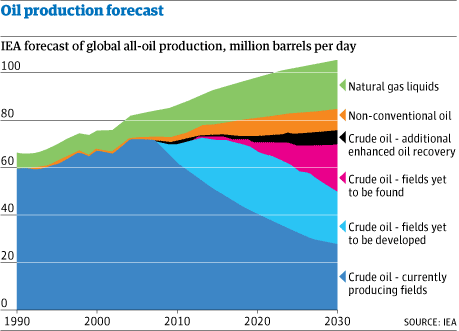
...Now the "peak oil" theory is gaining support at the heart of the global energy establishment. "The IEA in 2005 was predicting oil supplies could rise as high as 120m barrels a day by 2030 although it was forced to reduce this gradually to 116m and then 105m last year," said the IEA source, who was unwilling to be identified for fear of reprisals inside the industry. "The 120m figure always was nonsense but even today's number is much higher than can be justified and the IEA knows this....
Read the whole thing...

Tuesday, October 06, 2009

Coal Is Too Dirty... :)


I didn't realize that some college campuses have their own coal-fired power plants. Time for a change....

Sunday, November 09, 2008

Futuristic Green Transit: 10 Vehicles for 2010

Want to green your ride, but can’t afford a Tesla? That’s okay… there are plenty of cool (if not quite so flashy) new transportation options coming down the pike that will cost you less than $100,000. Some of ‘em you can even build yourself.

Seriously Strange Fossil Fuelings:

Who needs hydrogen? Some energy alternatives have been around for years, and are making a comeback.

1. Wood

It’s not talked about as much as the Manhattan Project, but there was a big energy crisis during WWII, when the military sucked up a huge portion of the world’s petroleum output. Individual car-owners across Europe converted their cars and trucks to run on… wood.car_wood_truck051008_1a.jpg

Wood?

Wood. Engines don’t run on liquid gasoline - they literally run on fumes. Same goes for the fire in your fireplace – when you see flames rising, that’s the fumes of volatiles coming off the logs and igniting. You can do the same thing in your car.

Some folks are working on making this high-tech, with scrubbers and sealed, carefully controlled burners. Renewable Energy Systems are currently running a demonstration coast-to-coast tour with a couple of modded 1991 Dodge Dakota V8 pickups.

But for now you can go very low-tech – plonk a stove on the back of your pickup and run a vacuum hose to the carburetor; after that your spark plugs ignite the fumes as per usual. You can get information on the web to rig your vehicle with a hundred or so dollars in parts: Jim Mason offers workshops and info, or order a how-to guide from Mother Earth News.

But either way, your fuel can be wood if you want – or any scrap biomass.

2. Steam

british_steam_car.jpg

The British Steam Car looks like the Batmobile and runs like an iron horse. It is not quite road-ready just yet, though, as it guzzles 1,000 litres (one ton!) of water per 25 minutes of travel time. So for now it is recommended only for shorter commutes (or perhaps not at all).

3. People Power

car_humancar.gif

HumanCar is driven by people - even the steering is human powered, like on a bicycle or motorcycle.

How does it work? They’re being very, very cagey – there’s lot of talk on their website about patents and proprietary trade secrets, not too much on how it will run.

But for sure, this won’t be a Flintstones-style feet-through-the-floor operation.

Already on the Market:

4. ZAP Xebra

car_zap_xebra.jpg

Perfect for in-city commuting or shopping, this little car only has a 25-mile range. Still, it brags that even after counting emissions from generating the electricity it uses, it produces 98% less pollution than a gas vehicle. And it’s available now. Next up: A ZAP trucklet with a solar panel to fuel itself.

5. Smart Fortwo

car_Smart_Fortwo_On_Street.jpg

This may look like a toy, but it pumps out 110 horsepower (between a 4-cylinder gas engine and a 50-kilowatt electric motor) And it is kind of cute. This vehicle seats two comfortably (depending on the individual, of course); at a stretch you can cram in thirteen contortionists.

Future Green Transport:

6. Zoop

car_zoopcar.jpg

This little electric flitter can travel at up to 120 mph (although that prospect raises the specter of “Unsafe at Any Speed”). The Zoop is more about being seen – hence the clear canopy and the flashy design by EV-proponents André and Coqueline Courrèges of Paris-based fashion house Maison de Courrèges.

7. Ecooter

car_ecooter_side.png

It is hard to say whether this Chinese offering is even a car, and even the name implies it is some sort of scooter…

Still, it has four wheels (in a diamond layout, rather than the standard “four corners” formation) and there is a roof over your head to keep out the wind and rain, so perhaps it qualifies.

The way it parks is particularly interesting - thanks to the diamond wheelbase, you can do some remarkably tight turning with this little thing:

7. Loremo

car_loremo.jpg

The name stands for “Low Resistance Mobile” This just goes to show that you don’t need to wait for next decade’s technology to accomplish amazing things with milage: The Loremo combines a highly-efficient German-engineered diesel engine with extremely low-drag design to achieve 150 miles per gallon. Coming next year to Europe, with US launch to follow.

8. Helios

car_helios_99dty_69.jpg

Want to really get off the grid? Helios has the answer: a solar-powered buggy with a saurian solar sail that spreads out to soak up the sun and recharge, photovoltaicly. This concept car won the Best Use of Technology at the Interior Motives Design Awards 2008. Note to racers: do NOT attempt to deploy the sail as a drag chute…

9. The Air Car

car_airpod.jpg

Coming as early as spring 2009 from MDI and Zero Pollution Motors, it runs on compressed air. Developed by Formula One engineer Guy Nègre, the Air Car is expected to make big inroads in India, where it will be sold as the Tata Nano for $2500.

10. VW 1-Liter

Car_VW_one_liter_car.jpg

A few of the mainline automakers are trying to break out of the gas-guzzler mode (although not GM, who have announced they won’t be bringing their min-cars to the US market, further demonstrating their brilliant business acumen and why the government should give them a big bailout.) VW wanted a car that would go 100 miles on one liter of gas, but it’s taken them more than six years to perfect the high-tech low-weight materials like carbon fiber and titanium. Along with a super-sleek aerodynamic shell, this diesel-powered commuter car is scheduled to get a spectacular 235 mpg when it hits the roads (in a limited edition test release) in 2010.

Can’t wait - or really want to do something now? Don’t despair - you can upgrade your current rustbucket to at least make it a little more fuel-efficient.

Monday, September 01, 2008

Termites and hydrogen


Searching for a miracle... a fuel source that is actually efficient.

Ethanol has been a disaster, barely breaking even in energy output, not doing well at all in carbon footprint, and driving up the price of corn and other grain. Time to try something else.

Hydrogen hasn't been much better, so far - it's still not cost effective. We simply don't have an industrial process to make it cheaply and in bulk. Wouldn't it be nice if we did? Termites, and the microbes in their guts that allow them to digest wood, could change that.

Termites? Termites!
A worker termite tears off a piece of wood with its mandibles and lets its guts work on it like a molecular wrecking yard, stripping away sugars, CO2, hydrogen, and methane with 90 percent efficiency... Offer a termite this page, and its microbial helpers will break it down into two liters of hydrogen, enough to drive more than six miles in a fuel-cell car. If we could turn wood waste into fuel with even a fraction of the termite’s efficiency, we could run our economy on sawdust, lawn clippings, and old magazines.
Check out the article... it's fascinating.

Friday, July 18, 2008

The Al Gore Challenge

Check out the website here.

See highlights of the challenge on YouTube:


Annotated version on the New York Times' Dot Earth blog...

Tuesday, March 18, 2008

Tilting Windmills


(Cross-posted from 3rings)

Wind power has been part of the energy landscape for thousands of years. But in the nuclear era, it was viewed as quaint - “Tilting at windmills” became a metaphor for fighting hopeless battles against the forces of change. Mind you, Helix Wind of San Diego does come off a bit quixotic in their corporate philosophy: “Freedom is at the heart of our values – energy independence and autonomy – a freedom fueled by a resource that never runs out. The wind.”

But this ain’t Cervantes’ windmill. Not only is their Savonius more efficient, simpler to set up and less expensive to buy than your average model - it’s also flipping gorgeous. When I saw this sleek, nautilus spiral at the Wired NextFest, it took my breath away.

The key to the design: vertical orientation, which eliminates a lot of traditional windmill issues. When folks apply for zoning variances to install wind power, they’re nearly always battled by neighbors who say (quite rightly) that windmills are ugly, noisy, obtrusive, and dangerous to birds and other wildlife.

All of those problems are eliminated in the Savonius. Instead of horizontal propeller-like blades with tips that spin at very high speed (noisy!), and must therefore be set very high above the ground (dangerous!), the Savonius spins vertically, with no more noise than wind blowing through the trees, on a pole (no tower) that doesn’t cost an arm and a leg. Oh, bird-lovers should note that at the low speeds the Savonius spins, you never have to worry about it taking on that translucent look that encourages birds to try to fly through it…

The Savonius currently comes in two configurations: 1 kw for residential applications, which stands 9’ feet tall by 4’ feet in diameter (2.74m x 1.21m). The commercial turbine, the Helix 2 kw measures 12’ feet in height by 4’ feet in diameter, (3.6m x 1.21m).

And there are rebates - if you live in California, the state will cover up to 77 percent of the cost; other states are coming on board, as well. Helix Wind even has a calculator function on the website to help you work out the financials.

But we shouldn’t worry about such Philistine considerations… what, after all, is the true price of beauty?

Thursday, February 14, 2008

Biofuels: "Worse than we thought"

The word has been trickling out that the latest attempt by big energy to jump on the green bandwagon is, in fact, an environmental disaster.

Via Kevin Drum, biofuels guru Mike O'Hare says recent studies have shown that, once you take all the factors into account, corn-based ethanol and similar fuels actually dump much more CO2 into the environment.
There is now more than good reason to expect that no biofuel from seeds, possibly none (even cellulosic) grown on land that could grow food, will reduce global warming if substituted for petroleum products...

(There's more...)

The first piece of the puzzle is the recognition that if a piece of forest is cut down, or natural grassland plowed up, to grow biofuel, decay and/or burning of what was there before releases an enormous puff of carbon into the atmosphere that needs to be counted along with the carbon releases of the biofuel crop. Even spreading the initial release over decades of biofuel growing, it is large enough to push almost any biofuel's global warming intensity way above that of gasoline, especially because it all occurs right at the beginning of the future rather than a few years or decades down the line...

Small amounts of diesel and ethanol will probably be available from trash and agricultural waste like the tree branches and bark scraps the logging industry leaves around to decay, or cornstalks, or McDonald's used frying oil, and these are environmentally OK because they don't induce land use conversion....And many smart folks in this business expect that algae growing in tanks in the desert (for example) can eventually be taught to make a lot of diesel cheap, with no land use implications. But for now, and for a while, biofuels generally are going over a very rough patch of road, a patch that may go on for years before new technologies smooths it out again.